Portugal’s tourism identity is deeply tied to its traditions, craftsmanship, and storytelling. Among its most recognizable icons is the famous Rooster of Barcelos, a colorful figure that represents faith, justice, and cultural heritage. Its journey from a local legend to an internationally recognized symbol reflects both history and the evolution of Portuguese tourism.
The Legend: A Story of Faith and Justice
The origins of the rooster symbol are rooted in a medieval legend from Barcelos, a town in the Minho region known for its strong artistic traditions. According to the story, the town’s inhabitants were once troubled by a crime whose culprit remained unknown. One day, a Galician pilgrim passing through on his way to Santiago de Compostela became the prime suspect.
Despite his repeated claims of innocence, the authorities arrested him and sentenced him to death. Before his execution, the man requested to be brought before the judge who had condemned him. The judge was at a banquet, seated before a roasted rooster. The pilgrim declared that he was as innocent as it was certain that the rooster would crow when he was hanged.
The claim was met with laughter, yet no one dared touch the roasted bird. Miraculously, at the moment of the execution, the rooster stood up and crowed. Realizing the grave mistake, the judge rushed to the gallows and found that the man had survived—the loose knot of the rope had prevented his death. The pilgrim was freed and, years later, returned to Barcelos to erect a monument in honor of the Virgin Mary and Saint James.
This legend, preserved as part of the heritage of the Museu Arqueológico de Barcelos, became a powerful symbol of justice, faith, and divine intervention.
From Craft Tradition to International Recognition
The rise of the rooster as a national symbol is closely linked to the region’s pottery tradition. Barcelos has long been known for its clay figurines, which remain one of the strongest artistic expressions of Minho. Among these, the rooster stood out for its vibrant colors and symbolic meaning.
Its transition from local craft to international icon began in 1935, when it was showcased at the Portuguese Folk Art Exhibition in Geneva. This marked its first major international appearance. The following year, the exhibition was held again in Lisbon, achieving remarkable success and further promoting the figure.
From the 1950s and 1960s onward, the Rooster of Barcelos became firmly established as a symbol of Portuguese tourism and national identity. It appeared in fairs, exhibitions, and promotional campaigns, often representing a Portugal of folklore, traditions, green landscapes, sunshine, and warm hospitality.
Over time, it became impossible to visit Portugal without encountering these colorful roosters—whether displayed in shop windows or carried home as souvenirs. The image resonated with both locals and international visitors, becoming a visual shorthand for the country itself.
A Registered National Brand
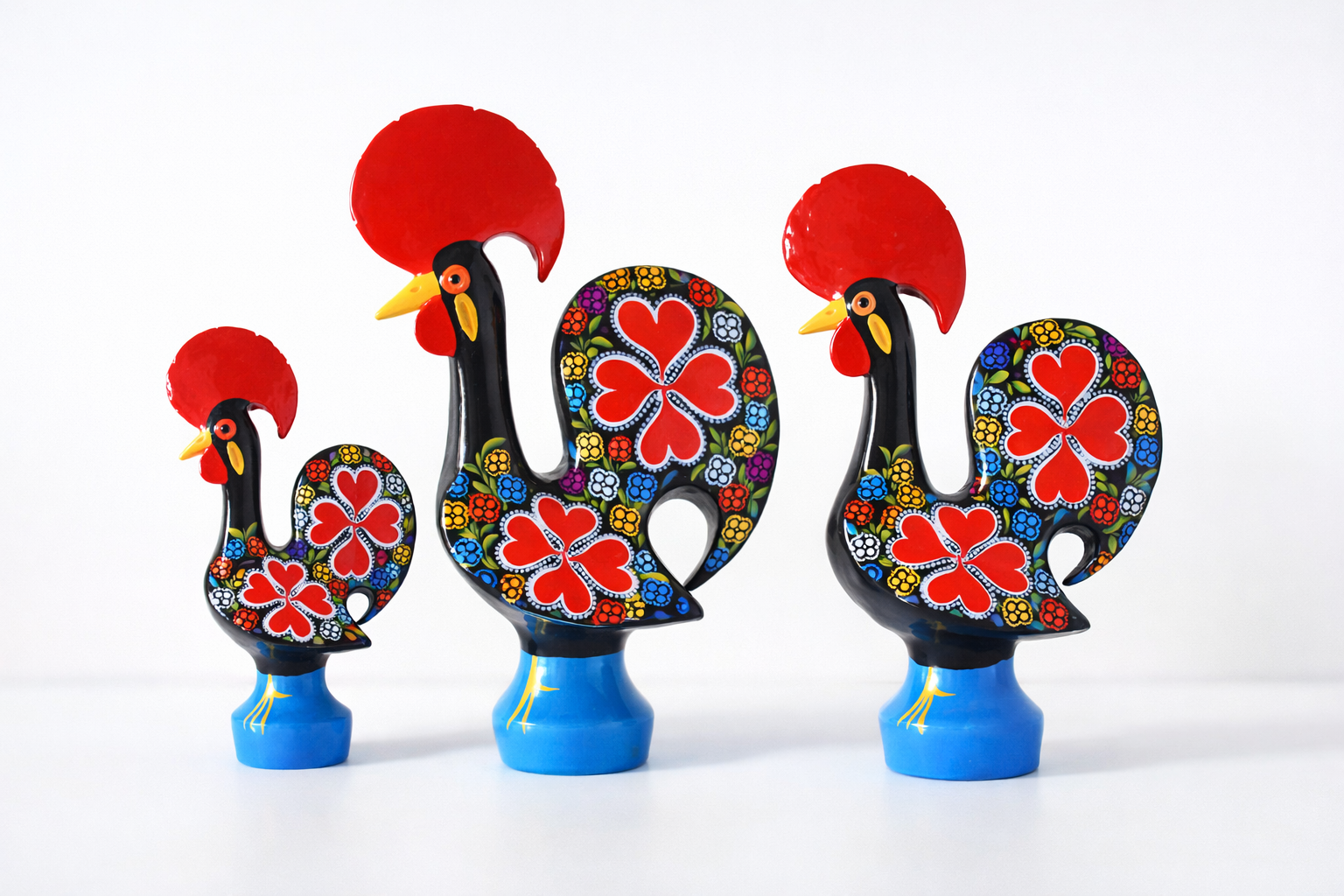
In recent years, the Rooster of Barcelos has taken on an even more formal role as a symbol of Portugal. In 2021, its image was officially registered as a national trademark. The registered figure is defined as a black rooster with a yellow beak and red crest, decorated with floral elements in vivid colors—especially red—reflecting the traditional style of Barcelos ceramics.
This registration grants legal protection, allowing authorities to prevent the unauthorized use of similar symbols on related products or services. The Municipality of Barcelos is the official holder of this trademark, ensuring that the authenticity and cultural integrity of the rooster are preserved.
Today, the rooster continues to play a central role in tourism promotion and cultural representation. It bridges past and present—linking a centuries-old legend with modern branding strategies—while remaining a proud symbol of Portuguese identity.
The Rooster of Barcelos is far more than a decorative object. It is a story, a tradition, and a national emblem that reflects Portugal’s history and values. From a miraculous legend to a globally recognized icon, it continues to captivate travelers and preserve the spirit of a country rich in culture and meaning.